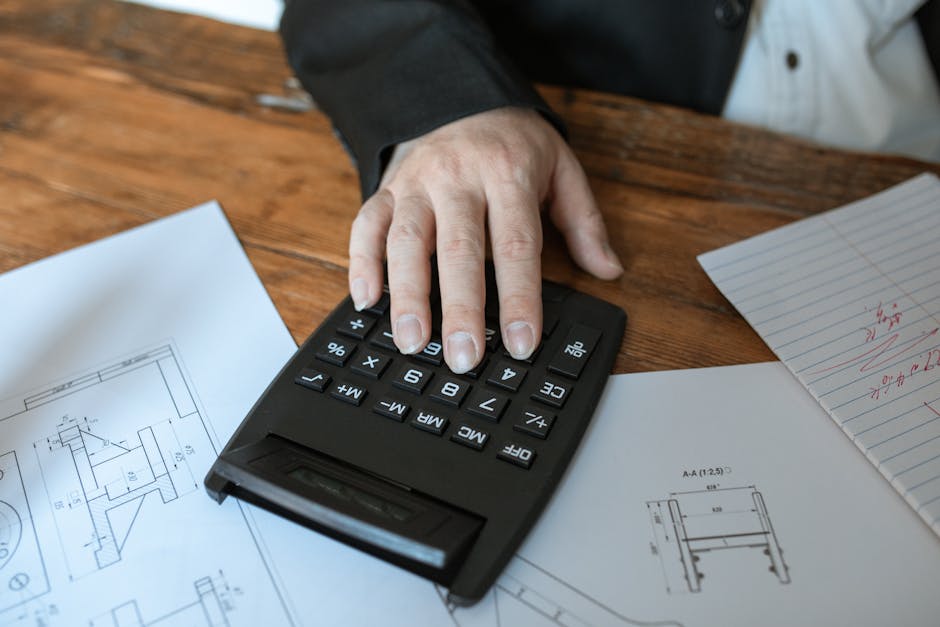
An adu construction cost calculator is the fastest way to turn vague budget anxiety into a real number you can plan around.
Here is a quick snapshot of what many homeowners in California pay, based on the ADU type they are pursuing:
JADU (Junior ADU): $30,000 - $100,000, or roughly $100 - $200 per square foot
Garage Conversion: $80,000 - $150,000, or roughly $125 - $200 per square foot
Attached ADU: $120,000 - $280,000, or roughly $150 - $250 per square foot
Detached ADU: $200,000 - $500,000+, or roughly $180 - $300 per square foot
Prefab ADU: $100,000 - $350,000, or roughly $100 - $250 per square foot
Quick answer: Most ADU projects in California land between $180,000 and $400,000, depending on type, size, site conditions, and finish level. A common statewide median lands around $150,000, or roughly $250 per square foot.
Planning an ADU in Los Angeles feels overwhelming at first. Permits, zoning rules, soil conditions, and contractor bids all affect whether your budget is realistic before you even get to drawings or approvals.
That is exactly where a cost calculator helps. It gives you a working estimate early, before you spend money on design, engineering, or permit submissions. It is not a final contract price, but it is a useful starting number for deciding whether the project is financially feasible.
The catch is that these tools are only as good as the information you enter. Site slope, utility access, finish choices, and local permit fees can shift the final number by 15 to 25 percent in either direction.
This guide explains how to use these tools properly, what drives ADU cost up or down, and how to build a budget that holds up through permitting and construction.
How to Use an adu construction cost calculator Effectively
To get useful output from an adu construction cost calculator, you need to treat it as a structured planning tool, not a magic answer box. These tools work best when they are fed project-specific information such as unit type, square footage, location, and anticipated finish level.
At a practical level, every calculator is trying to estimate two main buckets of money: hard costs and soft costs.
Hard costs: labor, lumber, concrete, roofing, plumbing, electrical work, windows, doors, finishes, and the physical construction itself
Soft costs: drafting, structural engineering, permit fees, plan check costs, surveys, and similar non-construction expenses
If you enter only a square footage number without identifying whether the project is a detached ADU, attached ADU, or garage conversion, the estimate will often be too generic to be useful. For a more local look at pricing patterns, review our Los Angeles ADU Cost Breakdown.
Why You Need an adu construction cost calculator
The primary reason to use a calculator is budget accuracy. Without an early baseline, it is easy to underestimate by tens of thousands of dollars and find out too late that the design you want does not match the financial reality of the project.
A calculator also helps test project feasibility. It tells you whether a target unit type and size are even in range before you commit to consultants, drawings, or permit prep. It can also help you compare options, such as whether a garage conversion is a better starting point than a detached unit.
Good calculators also reflect material and labor conditions in a specific region. That matters in Southern California, where labor and construction demand in places like Pasadena, Glendale, and the San Gabriel Valley can differ sharply from national averages.
Limitations of an adu construction cost calculator
No online calculator can see your yard, your utility locations, or your soil conditions. Site-specific realities are where many estimates start to move.
Market fluctuations: material prices can change between budgeting and procurement
Permit fee changes: cities update review and fee schedules regularly
Property-specific variables: slope, access, trenching distance, and utility upgrades can materially change cost
Variance range: it is smart to assume a 15 to 25 percent planning range, not a single perfect number
That is why owners should still carry a buffer and review common local budgeting problems. For example, these Hacienda Heights ADU Budget Mistakes to Avoid show where many early numbers start to break down.
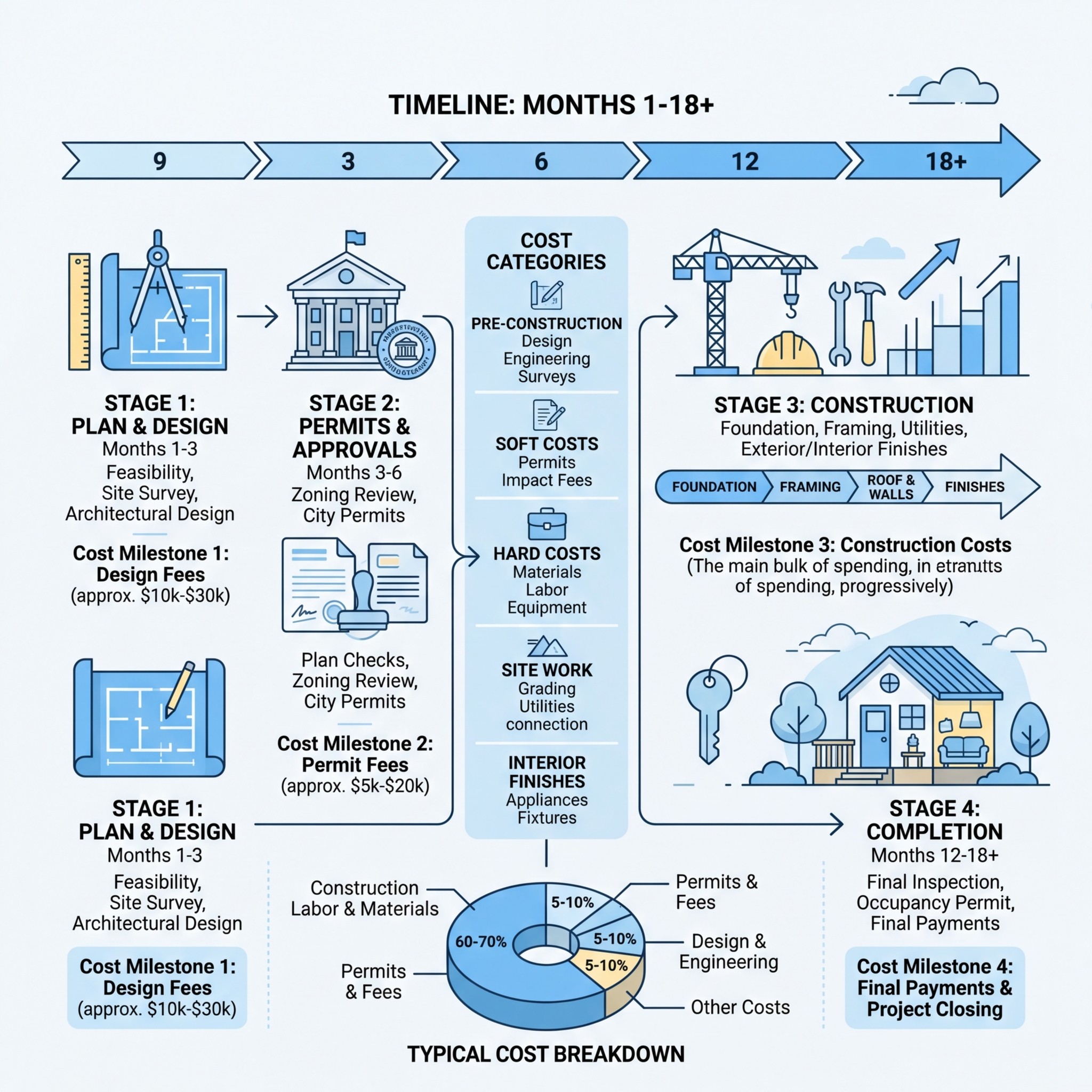
Primary Factors Driving ADU Construction Costs
Why does one 500-square-foot ADU cost $150,000 while another costs $250,000? The answer is rarely just size. In most cases, the biggest drivers are site conditions, finish level, and local review requirements.
That is why project cost in Los Angeles is highly location-sensitive. The same unit type can price differently depending on the city, the lot, and how the design needs to respond to the site. For another city-specific example, review our Glendale ADU Cost Breakdown.
Impact of Site Conditions and Utilities
In Southern California, the land often drives the budget as much as the building.
Lot slope: a flat lot is significantly easier and cheaper to build on than a steep backyard that requires retaining and more complex drainage
Soil stability: poor or expansive soils may require deeper foundations or special footing strategies
Utility trenching: the farther the ADU sits from sewer, water, or electrical tie-in points, the more site work is required
Electrical upgrades: many older homes need panel upgrades before an ADU can be supported properly
Finish Quality and Material Selection
Finish level is one of the biggest cost variables you control. Standard, durable finishes keep the budget tighter, while high-end tile, custom cabinetry, premium flooring, and upgraded appliances can raise costs quickly.
California energy compliance also adds real cost. Title 24 requirements, insulation performance, efficient HVAC equipment, and detached-unit solar obligations can all affect the final number, even though they can improve long-term operating performance.
Average Cost Breakdown by ADU Type and Size
The type of ADU you choose is often the biggest factor in total cost. Reusing an existing structure is generally less expensive than building a new standalone unit from scratch.
Detached ADU: highest privacy and often strongest rental value, but usually the highest total construction cost
Attached ADU: can save on some structural duplication, but may create more code and integration complexity
Garage Conversion: often the most efficient path because the shell already exists
JADU: the most budget-friendly option, but size and placement are more constrained
For a broader comparison of unit configurations, review our guide to Types of ADUs.
Detached vs. Attached ADU Expenses
A detached ADU has its own foundation, roof, exterior walls, and independent site utilities. That gives the owner and tenant more separation, but it also means more construction scope. In Los Angeles, detached units often carry the highest cost per square foot.
An attached ADU may save money on some structural and exterior envelope components, but it can introduce new code coordination issues around the connection point, wall assemblies, and permit review.
Garage Conversions and JADUs
If your goal is the fastest and most cost-effective route to a usable unit, a garage conversion is often the strongest candidate. The foundation, roof, and wall framing already exist, which reduces the amount of brand-new structural work required.
JADUs are even more budget-conscious because they must stay within the existing envelope of the primary residence. They are smaller and more constrained, but they often move faster and require less total investment than a detached build. For related timing expectations, review our Los Angeles ADU Construction Timeline.
Budgeting for Soft Costs and Permits
Many owners focus only on physical construction and forget the planning side of the budget. In Los Angeles County, soft costs commonly account for 15% to 25% of the total project cost.
Architectural and Engineering Fees
You cannot build an ADU from a rough sketch. You need permit-ready drawings, structural input, and often site verification.
Drafting services: accurate plans that communicate how the ADU will be built
Structural calculations: engineering support to satisfy code and plan review requirements
Site survey or measurement work: needed when setbacks, layout, and placement have to be verified accurately
On many projects, design and engineering services together land between $5,000 and $20,000, depending on scope and revision needs. For more local permit context, review our Los Angeles ADU Permits and Los Angeles ADU Permit Checklist resources.
Government Fees and Contingency Funds
Every city charges for plan review, approval, and final permit issuance. Some ADUs under 750 square feet avoid certain impact fees, but larger units may still trigger additional costs.
A strong budget also needs a contingency. Unknown conditions, utility issues, corrections, and site surprises happen often enough that a reserve is not optional. If your calculator says $200,000, it is reasonable to plan for something closer to $220,000 if you want the budget to absorb problems without becoming fragile.
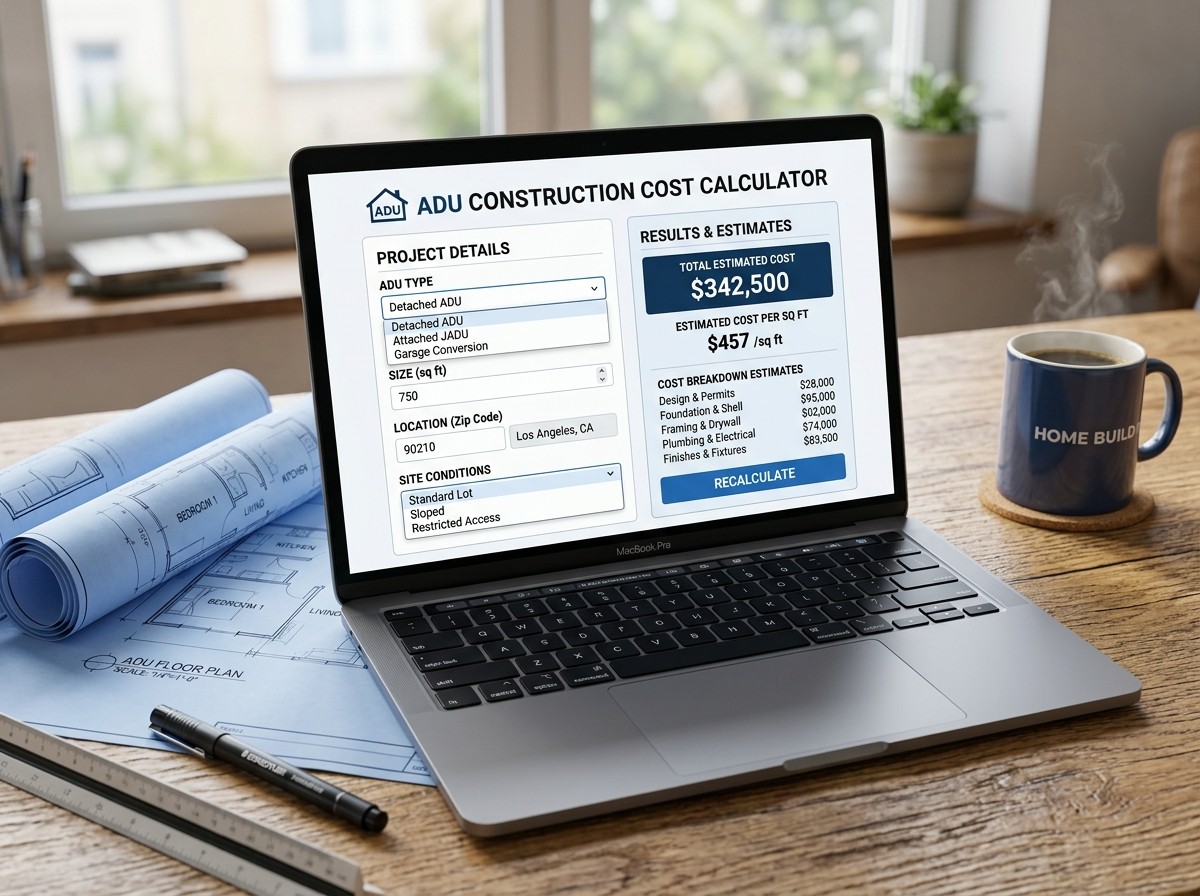
Maximizing ROI and Financing Your Build
An ADU is not only a construction expense. It is also an income-producing or value-building asset. In California, a well-executed ADU can improve property value materially while also creating rental flexibility or multigenerational housing options.
Many owners use the ADU to strengthen long-term equity while also improving monthly cash flow. For a more focused discussion of money strategy, review Los Angeles ADU Budgeting and Financing.
Financing Options for Homeowners
Most homeowners are not paying cash for the full build. Common financing paths include:
HELOC: flexible access to home equity with staged use of funds
Cash-out refinance: replacing an existing mortgage with a larger one and using the difference for construction
Construction loan: a project-specific financing structure that releases funds in stages
Renovation-style loan products: helpful for buyers who plan to improve the property soon after purchase
With strong rental demand across Los Angeles and the San Gabriel Valley, many ADUs produce a multi-year payback window that remains attractive compared with leaving the yard underutilized.
Calculating Your Rental Yield
Rental yield depends on unit type, location, privacy, parking context, and finish level, but the broad ranges many owners see are:
Studio ADU (300-400 sq ft): about $1,500 - $2,200 per month
1-bedroom ADU (500-700 sq ft): about $2,000 - $2,800 per month
2-bedroom ADU (800-1,200 sq ft): about $2,800 - $4,500 per month
When evaluating return, remember to account for maintenance, insurance, taxes, vacancy assumptions, and long-term replacement costs rather than looking at rent in isolation.
Frequently Asked Questions about ADU Costs
How accurate are ADU cost calculators for 2025 and 2026?
They are useful for early planning, but they should not be treated as the same thing as a contractor proposal. A realistic planning assumption is still a 15% to 25% range because calculators cannot fully account for your exact site conditions, utility routing, soil characteristics, and permit comments.
What is the cheapest type of ADU to build?
In most cases, a JADU or a garage conversion is the least expensive route because it reuses existing structure. That said, the cheapest path still depends on whether the existing conditions are sound enough to avoid heavy retrofit work.
Do ADU cost estimates usually include permit and impact fees?
Basic calculators often do not. Better tools include at least a soft-cost category, but owners should still assume that design, engineering, permit review, and fee costs need to be checked separately against the city and project scope.
Conclusion
An adu construction cost calculator is the right place to start because it turns a broad idea into a budget conversation you can actually evaluate. It helps you compare unit types, test feasibility, and understand whether your project belongs in the $100,000 range, the $250,000 range, or far above that.
What the calculator cannot do is replace site knowledge. Local permit pathways, utility conditions, lot slope, and finish expectations are what determine whether the first estimate is directionally correct or badly understated.
At Uni Construction, we help owners turn early budget assumptions into permit-ready plans and realistic next steps. If you want to stop guessing and move toward a buildable ADU path, start with our ADU Design service or contact us for a feasibility conversation.